Adam Nieman
... some selected workFor other content by or about Adam Nieman see: LINKS
For other content by or about Adam Nieman see: LINKS
 Artist's Statement
I generally set out to locate viewers in the world (universe). The ‘location’ is not necessarily geographical, for instance it is often large numbers that need navigating but generally it sets out to say: ‘this is the world and this is you in it’. Both the viewer and the world itself (as perceived by the viewer) should be augmented by the experience.
Often the work itself is not the focus of attention. It acts instead as a nexus connecting the viewer to the world; it is a pointer or a map rather than an isolated artefact. It doesn’t say ‘look at me’, it says ‘here we are’. The viewer is always present in the work.
I am interested in scale and the tension between the human scale through which we perceive the world and the extreme scales at which the world is conceived in scientific thought. My background in physics informs this preoccupation because physics gives us access to the rest of the universe. Whilst non-physicists are usually restricted to the 'human scale', physicists can mentally inhabit spaces the size of the of the universe and spaces many orders of magnitude smaller than atoms just as easily.
Physicists are also at home with phenomena that take billions of years or take the tiniest fraction of a second. But it is not just scale. Physics also gives us access to aspects of the universe in which we struggle to locate ourselves. Mathematically we can conceive of a world inhabited by entangled photons and can easily navigate imperceptible dimensions but these are difficult ideas to have a ‘feel’ for.
There is a disconnect even for physicists between the perception of the world and how it is conceived. My work often sets out to relate mathematical insights to our embodied experience of the world – to include the rest of the world in our lived experience. Where possible, the aim is to give viewers a ‘feel’ for phenomena and their own relationship to them but my work eschews pastiche. Only an authentic connection with the world is acceptable. Where it is not possible to provide an intuitive sense of the phenomenon represented, my work will not impose meaning or fix an interpretation. The work is ‘about’ the viewer's own relationship with the world as much as it is a representation of the world.
 Space Signpost
(interactive sculpture)
Space Signpost
(interactive sculpture)
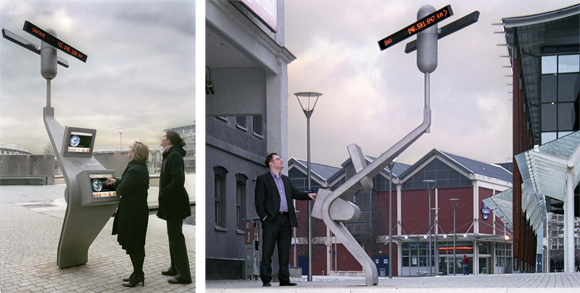
Space Signpost is an interactive sculpture that points to objects in space selected by users.
The original name for Space Signpost was 'Welcome to the Neighbourhood' as it sets out to expand viewers sense of the space they inhabit. It offers a direct connection with objects in space unmediated by astronomers.
It was installed in Millennium Square in Bristol in 2006 and will remain there for the foreseeable future. A new Space Signpost will be installed in Warsaw in the summer of 2010. It was developed in collaboration with Futurelab with a grant from the Royal Society
Click for more...
 Air and Water
(graphics)
Air and Water
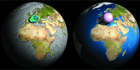
(graphics)  This image won a Visions of Science Award in 2003.
 Rich Mix Moon
(Kinetic Sculpture)
Rich Mix Moon
(Kinetic Sculpture) 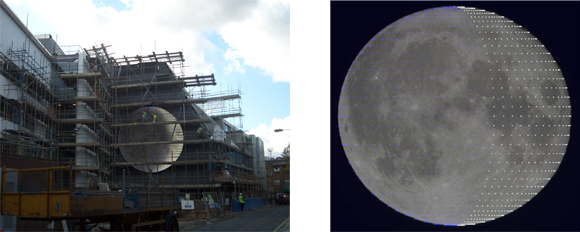
Commissioned by the Rich Mix Arts Centre in Bethnal Green, London (not built)
An image of the Moon is painted directly on the flat panel of an assembly of 1296 lights. The arrangement of the lights is a flat projection of points on the Moon’s surface separated by equal angles. This is what gives the display a striking 3D appearance even when viewed from oblique angles. The lights that are on correspond to the areas of the Moon in sunlight. An algorithm devised by Islamic astronomers ensures that, following new Moon, the first lights are on at the precise moment the crescent Moon becomes visible. The system is synchronised by atomic clocks to ensure it can be relied upon.
 Numbers
(print works)
Numbers
(print works) 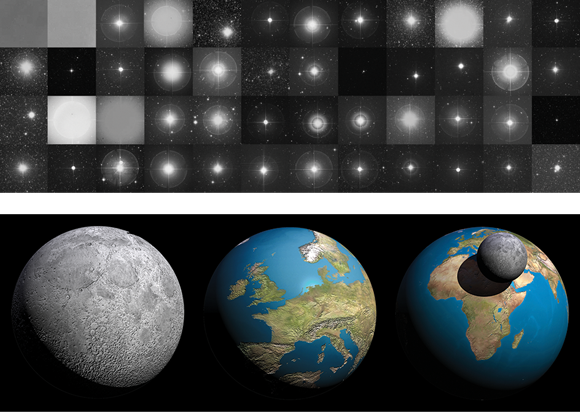
Numbers was a wide ranging show with a focus on making abstract quantities concrete. It included portraits of our neighbouring stars (top), comparisons of the Earth and Moon by volume and surface area (bottom), a map of the atmosphere above London to the edge of space, a portrait of all 302,000 people who work in the City of London, a representation of 385 parts per million (the concentration of carbon dioxide in the atmosphere at the time) amongst other images.
Click for picture list (PDF).
 Local Stars
(kinetic sculpture)
Local Stars
(kinetic sculpture)
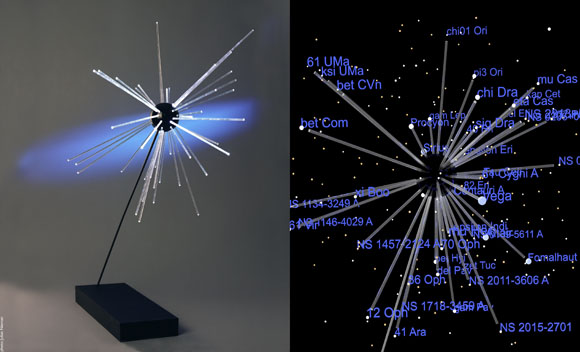
Local Stars – acrylic rods, motor, LED lighting. This 'ecliptic work' (so called because it remains aligned with the ecliptic) is the largest kinetic sculpture ever built. The assembly remains aligned with the galaxy as a whole if (a) the axis oriented toward the north; (b) the angle the axis makes with the ground is the latitude of the machine's location; and (c) the period of rotation is one sidereal day (23 hours 56 minutes). The stars in this ecliptic work are the 48 stars within 10 parsecs (32.6 light years) of Earth that are visible to the naked eye.
Left: central portion, 1.5 m. Right: outer portion with a Local Stars installation (on an astronomical scale) superimposed.
 Gravity Haiku
(performance)
Gravity Haiku
(performance)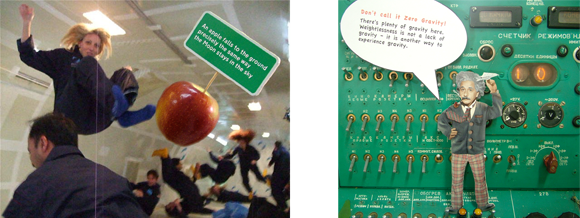
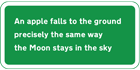
Left: "An apple falls to the ground, precisely the same way, the Moon stays in the sky"
Right: "Don't call it Zero Gravity! There's plenty of gravity here. Weightlessness is not a lack of gravity - it is another way to experience gravity."
When artist Luke Jerram was preparing for a flight on the Russian 'Vomit Comet' he invited me to make objects that he could take with him when he experienced weightlessness.
Gravity is a remarkable and beautiful phenomenon - a force that connects us to everything in the universe, a way to feel everything at once. It always saddens me when people describe weightlessness as 'microgravity' and believe it is an absence of gravity rather than another way (a richer way) to experience gravity. So I gave Luke a picture of Einstein to remind him that there was still plenty of gravity up there. The intention was to help us see parabolic flight as a celebration of gravity rather than a rebellion against it or liberation from it.
The apple and its accompanying haiku is homage to Newton and one of the best ideas anyone has ever had: what causes an apple to fall to the ground also explains why the Moon stays in the sky.
 Life Changes
(kinetic sculpture)
Life Changes
(kinetic sculpture)The film is a sketch for a work in progress. Life Changes connects viewers to the whole of humanity by marking the most significant moments of everyone on the planet - their birth and death. A white light indicates a birth near location of the light. A blue light indicates a death. The pinkness of the globe indicates the density of people.
The UK light flashes white every 49 seconds and blue every 52 seconds (on average). A white light will flash somewhere on the sculpture just over 4 times a second and a blue one will flash just under twice a second.
The film uses real birth/death statistics and so is a true representation of people being born and dying around the World.
 Tangent
(land art)
Tangent
(land art) Straight roads only look straight. Actually they are curved. The line of hoops in the film is a genuinely straight line. If you shone a laser from one end it would come straight out of the middle of the hoop at the other end. In the film, we are travelling at 130 km/h (81 mph); the hoops are spaced 100 m apart.
Tangent gives us a feel for the curvature of the Earth. It reveals the curvature on a scale we can relate to – a human scale. (OK, I’d rather see it from space too, but while that remains difficult Tangent is the best we can do :-)
A two dimension version in which a tangent plane is marked out by buoys is planned for installation in Lake Leman (Geneva).
 Allotment
(print work)
Allotment
(print work) 
If we divided the surface of the Earth equally between its 6.5 billion human inhabitants we would each have an area of land 22,898 m2 (2.3 hectares, 5.7 acres). In the pictures that area has been formed into an island 107 metres x 214 metres, surrounded by our share of the ocean. The types of land available: grassland, woodland, urban, desert, etc. has also been shared out fairly on this 'allotment'.
Click for more...